
Corporates remain cautious
Corporate occupiers remained cautious in Q1, particularly across Asia Pacific and Western Europe. Corporate activity in the United States appears to be maintaining more steady growth, in line with forecasts and despite federal spending cuts. Overall leasing volumes have been flat in Europe and have declined in Asia Pacific (year-on-year) but are increasing slowly in the Americas.
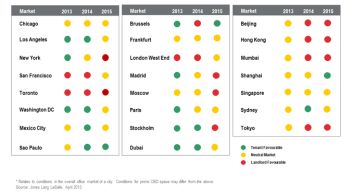
U.S. transitioning to landlord-favourable market
In the U.S., the stock market and, in particular, the housing market are inspiring cautious confidence in many MNCs. Existing home sales have increased by 8.1% year-on-year, which is the best pace since 2008, and this is driving strong economic recovery in the markets of the U.S. South and West.
In another bright sign for the U.S. economy, Goldman Sachs recently reported that it is tracking much stronger demand for loans from middle-market firms. This indicates that those businesses are gaining confidence and looking to grow, which is a positive indicator since middle-market firms are responsible for much of the space absorption in markets like Midtown Manhattan, Portland (Oregon) and Seattle.
With all these factors combined, Q2 or Q3 2013 may be the last quarter in which a majority of our tracked U.S. markets will be favourable for tenants. Absorption is finally increasing to the point where landlords may actually gain leverage in negotiations. In bottoming markets, tenants should look to lock into favourable lease terms while they last.
.. but market is shifting in favour of tenants in Canada
On the contrary, office conditions in Canada appear to be peaking, with landlords still probably holding the upper hand for another quarter, but conditions could quickly shift in favour of tenants as the country faces economic headwinds. The IMF recently cut its outlook for the Canadian economy, urging a delay in interest rate hikes, which signals increased uncertainty over 2013 growth prospects.
Activity slows across Asia Pacific
In Asia Pacific there has been a notable decline in corporate growth, and the first quarter was sluggish in terms of leasing activity. While this slowdown is to be expected relative to latter quarters, the nature of the downturn is concerning, as multinational corporations appear to be very cautious in their expansion plans and domestic firms are no longer carrying the balance. China remains the country with the greatest GDP performance and corporate expansions, but even here the pace of growth has been muted when compared to previous periods.
European corporates look to space reduction and outsourcing
In Europe, caution appears to be the reigning tone for corporate occupiers. The shadow of economic uncertainty combined with the restrained economic outlook for 2013 means that any leasing options are being carefully examined. Companies are responding with plans for both short-term and long-term downsizing, and are aggressively seeking opportunities for cost savings, through space reductions, relocations or the increased use of outsourcing.
Limited evidence of expansionary demand
In general, there is still little evidence of transformative or expansionary demand in the markets given the broad economic uncertainty and a general unwillingness from corporates to release capital expenditure. MNCs have been very slow to expand leased space, and even domestic corporations appear to be tempering their growth plans.
The key to increased market behaviour in 2013 will be improving underlying corporate confidence. In Asia Pacific corporates are showing reserved optimism, while in Europe confidence levels remain below long-term averages and will take at least a further six months to rebuild.
High structural vacancy
A major trend to watch in the advanced markets of North America, Europe and Australia is the high structural level of vacancy that exists in the office markets. As corporations increase revenue at a faster pace than employment, and continue to drive towards space density (which has been confirmed in Jones Lang LaSalle's Global Corporate Real Estate Survey), then they will simply need less traditional space going forward. For example, in the U.S., the vacancy rate remains stubbornly high at 17% and the prospective decline in vacancy is likely to be slower than in previous cycles, adjusting for strength of underlying economic conditions. Owners of existing buildings in the U.S. may need to anticipate relatively higher levels of vacancy over the course of the entire current cycle.
Source: Jones Lang LaSalle
