
Inflation pushes up Gautrain costs by R300m
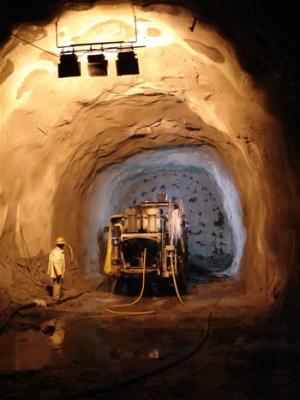
The cost of the Gautrain Rapid Rail Link has shot up by R300m because of a spike in the country’s inflation in the past couple of years.
Ceramic Industries earnings down 18.3%

Ceramic Industries reported an 18.3% decline in headline earnings per share to 376.1 cents for the six months ended January from 460.2 cents a year ago.
 South African tile and sanitary ware manufacturer Ceramic Industries (CRM) on Tuesday reported an 18.3% decline in headline earnings per share to 376.1 cents for the six months ended January from 460.2 cents a year ago.
An interim dividend of 110 cents per share was declared.
Revenue was 2.8% higher at R720.8 million, while operating profit was 17.6% lower at R92.8 million.
The group said the trading environment remained difficult for the period, in line with expectations, as demand slowed and consumers continued to rein in discretionary spending.
Although government continued its water, sanitation and housing infrastructure projects, there were indications of reduced activity ahead of the national elections to be held in April. As a result, demand for tiles and sanitary ware declined year on year.
International tile and sanitaryware factories have cut back on production capacity in reaction to the global economic slowdown.
While this lowered the risks associated with a global oversupply of tiles and sanitaryware, inventory levels across the industry are high, placing additional pressure on pricing in the local market and limiting Ceramic Industries' ability to recoup increased input costs.
The group said while the South African tile factories delivered a solid performance given the current environment, margins were negatively affected as cost pressure persisted and efficiencies were reduced by lower volumes.
The slowdown in government infrastructure spend had a more pronounced affect on the sanitaryware division which produced disappointing results.
The group's overall performance was also affected by a poor performance from the Australian factory, Centaurus.
Tile revenue improved by 6.3% to R609.8 million, but tile sales volumes declined by 2.8% in line with reduced demand.
The group, however, successfully increased overall selling prices by 5.3%. Reported sanitaryware revenue of R111 million was down 12.7%, reflecting the adverse market conditions.
Cash flow from operations declined by 26.7% to R136.5 million in line with lower profitability.
Looking ahead, Ceramic Industries said although interest rates are expected to continue easing in the second half of the financial year, discretionary spending will remain under pressure with subdued demand in the new housing market.
In addition, the group anticipates that the slower activity levels in the government's infrastructure and housing and sanitation programmes will persist for at least the next six months.
Although the demand for tiles has slowed, the group has demonstrated its ability to manufacture fashionable tiles and improve service levels and is positioned to continue benefitting from import substitution with a high quality and competitively priced offering.
The focus remains on optimising internal efficiencies at the lower current production levels to dampen the effects of ongoing cost inflation, it said.
The factories in the group's sanitaryware division are starting to overcome their internal challenges, although there remains much to be achieved. Betta and Sphinx will continue to focus on improving internal efficiencies to ensure their competitiveness.
Based on current market demand levels, the bath factory remains a challenge. In order to utilise excess production capacity, the division has also developed a new strategy to accelerate exports to Europe and the United Kingdom.
Ceramic Industries has invested over R450 million of internally generated funds in additional production capacity over the last few years. No additional investments will be made in the immediate future, and the group is well positioned to take advantage of any increase in consumer demand.
Although the outlook remains uncertain, Ceramic Industries' well-established factories, its strong balance sheet and broad customer base should enable it to continue generating acceptable results, it concluded.
Source: I-Net Bridge
Affordable Housing market still offers a good bet

The huge demand for housing in South Africa in the low to moderate income level, combined with declining rates and relative political and economic stability, continues to drive investment in the affordable end of the market.
Durban’s 2010 stadium reaches milestone

Fireworks were the order of the night when the lighting of the arch above the Moses Mabhida Stadium was celebrated in Durban on Saturday.
The who’s who in the political and soccer fraternity were present at the ceremony on Saturday. Local Organising Committee chairman Irvin Khoza, Sports Minister Makhenkesi Stofile, Premier S’bu Ndebele, and MEC Zweli Mkhize were among the dignitaries at the glittering event.
Ndebele said the completion of the arch symbolised unity.
“It is a celebration of teams working together to create not only an architectural and engineering masterpiece, but to physically create an icon that symbolises and spans years of history, hope and work, to let all South Africans feel the pulse of unification,” he said.
“South Africa is ready to host the 2010 Fifa World Cup. KwaZulu- Natal and Durban are ready to host the 2010 Fifa World Cup.”
Ndebele said South Africa was poised to make the 2010 World Cup an African event – one that will help spread confidence and prosperity across the entire continent.
“As hosts of the 2010 Fifa World Cup, South Africa stands not as a country alone – but as a representative of Africa, and as part of an African family of nations,” he said.
The stadium is named after one of the country’s most iconic struggle leaders, Moses Mabhida.
In 2006 the provincial government went to Mozambique and brought back the remains of Mabhida. He was laid to rest outside Pietermaritzburg.
Ndebele hailed the eThekwini municipality, saying the city was on track to complete the iconic stadium that will serve as a symbol of pride.
“We celebrate the completion of the stadium arch, which is a proudly South African architectural, engineering and construction milestone. ”
Gautrain gets into gear
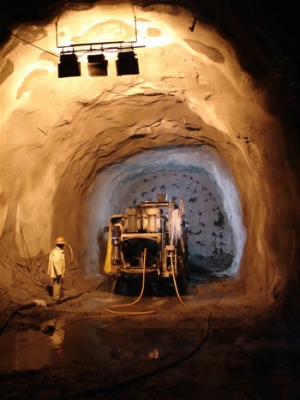
Around 150 guests including government and media set off from Midrand on the first trip aboard the rapid-moving Gautrain, whose arrival could transform the transport industry.
Construction groups bank on state work

Construction companies are counting on the government’s multi billion-rand spending programme in infrastructure projects to see them through the lean economic times caused by the global credit crunch, which has seen work from the private sector dwindle.
The global economic meltdown has created a lot of uncertainty for construction companies, most of which saw private sector work decline towards the end of last year.
A number of private sector clients of construction companies have suffered cash flow problems due to the financial crisis, which has affected certain projects.
From the second quarter of last year, the construction sector has been severely downgraded by the stock market on fears of a recession and depleted future work opportunities.
With commodity prices plummeting in recent months, the mining sector, which provides a big chunk of work to several construction companies, has scaled back on capital expenditure.
However, with the government reiterating that it will not put the brakes on its infrastructure spending programme, construction companies will be seeking more exposure to this public sector investment.
In his medium-term budget speech last year, Finance Minister Trevor Manuel said the government would continue to invest in several areas of infrastructure, including rail, roads, ports and energy in a bid to boost economic growth.
Group Five CEO Mike Upton said last week the group had a “reasonably good” order book to see it through the turmoil. “This (the order book) is quite well in tune with the public sector spending. The private sector has taken a turn for the worst, with capital spending, especially in mining, expected to drop significantly,” he said.
At the end of June last year, the group's one-year order book stood at R8,5bn, which it said at the time reflected its strategic positioning in the public infrastructure cycle with a mix of 65:35 in favour of public works.
“We are not negative at this stage but cautious.
“Our projections are not the same as last year, and we are not seeing the same security of work as we did six months ago. We have seen a number of projects from private sector clients that have been curtailed in recent months due to the credit crunch.”
WBHO CEO Louwtjie Nel said with work from the private sector drying up, the company was shifting emphasis towards government projects.
He said whereas two years ago the split between public and private sector work was about 20:80, that split was now about 50:50.
“We were traditionally focused on private sector clients, but we are now swinging in a big way towards government infrastructure work, such as roads, energy and hospitals — which should get us through 2009 quite comfortably.
“Beyond that, nobody really knows what is going to happen,” he said.
Nel said the group’s civils division was feeling the pinch the most as work, especially from the mining sector, had almost dried up.
“But overall we are now getting well exposed to government spend.”
Murray & Roberts said its outlook for this year had not changed from what it was in November when the group reported that it had been forced to restructure its operations in the light of the global credit squeeze.
The group said then that it had delayed or suspended some of its projects as some of its clients felt the pinch of the credit crunch.
“There are a number of significant public works and other strategic opportunities in the group's domestic and international project pipeline that are likely to proceed and which will provide stability through the difficult times ahead,” it said.
Catalyst Global Property Report - January 2009

December marked a slight recovery in the Global Real Estate Sector; all regions except for Australia were up for the month, with North America having a particularly strong month gaining 16.2%. There were also some good gains across Europe and Asia
No power-saving penalties for 2010 stadiums, Gautrain

Nersa says it has excluded the construction of stadiums for the 2010 World Cup and Gautrain from penalties that are part of the power conservation programme.
Raubex interim earnings up 80.5%

South African road construction group Raubex Group on Monday reported 80.5% rise to 144.6 cents in headline earnings per share for the interim period ended August compared with the same time a year ago.
An interim dividend of 30 cents was declared.
 Revenue swelled 131.7% to R2.23 billion, operating profit jumped 108.1% to R398 million and order book grew 113% to R4.9 billion.
Francois Diedrechsen, Financial and Commercial Director of Raubex Group, said the performance was in-line with our expectations.
"During the period we also successfully bedded down a number of acquisitions, the financial effects of which are included in this set of results," he said.
He added that the acquisitions were value-enhancing and performing well.
"Importantly, the depth and breadth of skills and capacity that they've brought to the Group positioned us well to continue taking full advantage of the spend driven by the government and private sector," said Diedrechsen.
Looking ahead, the group expects to deliver a strong performance in the second half as road upgrades gather momentum in the lead up the 2010 Fifa World Cup.
"With the Gauteng Freeway Improvement Project now underway, we expect the South African National Roads Agency Limited (SANRAL) to be announcing a number of reasonably sized contracts to be released for tender in the coming months," Raubex said.
SANRAL remains Raubex largest client, accounting for some 40% of its revenues.
World Cup projects still on track

Transport Minister Jeff Radebe says South Africa’s international airports will be primary beneficiaries of the 2010 soccer World Cup.

eProperty News is a leading online commercial property marketplace serving the Southern African Investment, Office, Retail and Industrial property and allied sectors.