
Demand
Demand is largely driven by blue chip companies taking up space in new developments due to a lack of adequate prime office buildings. These are notably, Samsung, Cell C, Nedbank, Ernst and Young, TWP, Standard Bank. Smaller companies are filling pockets of Grade P and A buildings in prime nodes whilst secondary nodes continue to endure increasing vacancies. Areas such as Bryanston, Hyde Park, Sandton and Midrand were nodes of choice in the current quarter.
Notable deals in this quarter include: Libstar relocating to the Rosebank node to take up larger office space (600m²), Global Trader’sleasing 450m² of space in Hyde Park, Quail Capital taking 350m² of office space in Bryanston as well asAlstom’s take up of additional 900m² spaces in their current building.
Supply
Notable completions were 8,500m² in Q1 2013,although the SAPOA vacancy survey recorded a 38,800m² increase in office stock due to reclassification of buildings. Office stock in the total Johannesburg office market amounted to 8,790,000 m² in Q1 2013. Completions were noted in the decentralised node of Bryanston, which included the 2,500m² completion on Hobart Street as well as the 6,000m² Samsung Building. In the next quarter, a further 71,000m² is expected in the market with the completion of the 65,000m² Standards Bank building in Rosebank and a 6,000m² building for DG Group.
Supply in 2013 is forecast to reach just under9 million m²(See Figure 3) as a result of the committed 167,284m² of office developments. However, developers are still exercising caution in the current subdued economic climate with about 77% of these developments still being non-speculative.
The Sandton, Midrand and Woodmead nodes seem to be gaining prominence as favourable development areas, considering the amount of development pipeline currently underway in these nodes. The biggest developments currently underway are 73,000m² of offices in the Waterfall Business Estate and an estimated 100,000m² of office developments in Sandton of which more than half are non-speculative. Redefine has recently announced plans to develop a 34,500m² office building for one of the prominent law firms, Webber Wentzel in Sandton.
Vacancies
Although overall national vacancies increased to 10.7% from 10.4% in the previous quarter, overall Johannesburg vacancies remained stable at 10.6% in the current period. More pressure continues to dominate the secondary buildings as vacancies for Grade B and C buildings continue to increase whilst Grade A buildings vacancies reduced to 6.9% from 8.7% in the last quarter. During the period under review Grade B vacancies increased from 13.7% to 15,6% and Grade C buildings increased from 20.1% to 22.9% in the last quarter. Good quality buildings and good location are still highly sought after, reflected by the further widening gap between prime and secondary buildings in the market.
Market Rentals
The average gross rental for Grade P increased 2.7% year on year, achieving an average of R171/m² despite there being no limited rental growth in the current period. The monitored top rental achieved during this period was R215/m², increasing 5% year on year from R205/m²achieved in the similar period in 2012. This rental increase was particularly achieved in the Melrose area, where prime offices are well above the market rental.
Grade A yielded a better rental growth in the current period, increasing 2.7% q/q to average a monthly gross rental of R121/m² from an average of R118/m² achieved in the previous quarter.
The Grade B average rentals achieved a marginal improvement with an increment of 1.3% year on year to achieve a monthly gross rental of R93/m² in Q1 2013. Rentals for this category of buildings remain under pressure due to increased building choice in many nodes. Even in good location, availability of secondary buildings is widespread.
Market Outlook
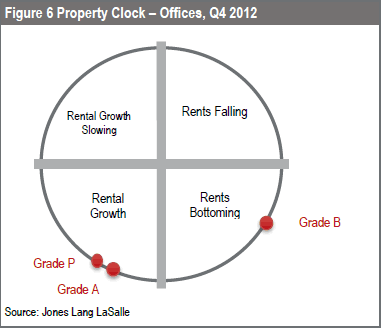
The office clock position for Grade A rental ticked to 7 o’clock as rentals on quality stock in good locations continue to yield growth. Market conditions for secondary office buildings continue to deteriorate in the current economic environment.
Vacancies in this category of buildings are expected to continue taking further knocks as market conditions are currently in favour of better quality stock in prime locations where demand prevails.
The prime market is landlord favourable as most prime buildings are achieving asking rentals since occupiers are prepared to pay a premium for quality and efficient buildings. Developers are however still holding back on speculative developments as they exercise caution.
