
Revitalisation of green point stretch reaches peak with development of R200M 169 on main

A R200 million 51-unit luxury apartment project on a vacant lot at 169 Main Road Green Point places the capstone on the radical transformation of the stretch between de Waterkant and Glengariff Road.
Cape Quarter mixed use centre attracting top tenants

The landmark Cape Quarter Lifestyle Village, situated in Green Point in Cape Town, has recently undergone several changes and has experienced rapid regeneration through the efforts of managing agents Spire Property Management and the owners of the building, the Tower Property Fund.
Demolishing Cape Town Stadium not an option
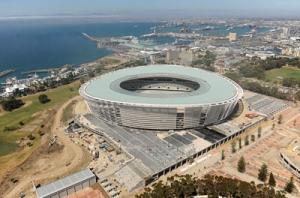
Cape Town Stadium Construction Under Investigation
An investigation is currently underway amidst claims that anti-competitive behaviour lead to the City of Cape Town being overcharged for the construction of Cape Town Stadium.
Interest In Cape Town’s Green Point Area Gathers Pace Among Retailers And Office Users

Interest and activity in prime located commercial property in Cape Town’s vibrant Green Point and De Waterkant areas continues to gather momentum, says Selwyn Sharon, leasing, sales and investment broker for JHI Properties.
All systems go for 2010 World Cup
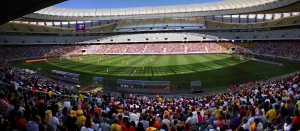
With one year to go, stadiums are nearly ready for the greatest sporting spectacle in the world.
Stadium on schedule for completion

Cape Town's 2010 stadium is on track for completion , but the city wants national government to deal with the cost overrun.
Orlando upgrade ‘on budget and on time’

WHILE most 2010 Soccer World Cup stadium construction and upgrade projects in SA have overspent their budgets, training ground Orlando Stadium has kept within its R280m budget.
 City of Johannesburg authorities said yesterday all the material for the stadium was bought long before the prices increased.
“We bought all the material in 2006 and kept it on site. What we couldn’t accommodate, like the roof, we found alternative storage space for,” said Deon Venter, the city’s official in the community development department.
Johannesburg mayor Amos Masondo said price increase projections were conducted even before contracts for the construction of the stadium were signed, as escalations were expected.
“There were interactions and engagements before the contracts were signed. We created the foundation to make sure that problems that happened elsewhere did not happen at Orlando.”
The stadium will be used as a training venue during the tournament. Its construction was 75% funded by the City of Johannesburg and 25% by the national government. It has been reported that the World Cup would cost the government R3bn more than the planned R9,8bn. Experts say this is because of increasing building material prices and general inflation.
Unlike at match venues across the country, construction had not been delayed at Orlando as there had been no labour disputes.
Disputed overtime payments and bonuses brought construction to a halt a number of times at the Mbombela stadium in Nelspruit, the Nelson Mandela Bay stadium in Port Elizabeth, Greenpoint stadium in Cape Town, Peter Mokaba stadium in Polokwane and the Moses Mabhida stadium in Durban. The City of Johannesburg said the first phase of the Orlando construction was 94% complete and that the entire facility would be completed in four months.
Councillor Ruby Mathang said labour disputes had not taken place because the building process was “people driven”.
“We sourced labour from across the entire Soweto area. We met community liaison officers and constantly had meetings with labour. The success was because people wanted to see this project succeed,” said Mathang.
Stadium workers want bonuses

Unions are seeking a R1500-a-month "project bonus" for all workers at Cape Town's Green Point 2010 stadium site, regardless of whether construction targets are met. They believe the bonus should be paid even if the workers go on strike.
This has emerged from the proceedings of an arbitration hearing held under the auspices of the Building Industry Bargaining Council (BIBC).
In an advisory award handed down this week, arbitrator Jacobus Koopman said the Labour Relations Act "clearly precludes the applicable unions from striking over matters bound by the collective agreement" -including the bonus.
The three-year agreement between unions and employers he referred to, which was reached in the BIBC, covers wages and conditions of service.
Green Point and other 2010 stadia under construction in other provinces have been dogged by strikes.
This week workers at the Mbombela stadium in Mpumalanga who were dismissed following a strike over wages allegedly burned a truck, motor bikes and a mobile office on the construction site.
A strike at Green Point in September last year led to losses of about R1 million a day.
Koopman's award followed an application brought by the National Union of Mineworkers and the Building Construction and Allied Workers Union against the Murray & Roberts/WBHO joint venture contracted to build the Green Point stadium.
The unions represent some 35% of the just over 900 workers on the site, the rest of whom are not unionised.
The unions complained that the employers had refused to negotiate at site level over a union proposal for a R1500 a month "project bonus" for all workers, not linked to productivity, and a R15 an hour wage increase.
The increase would be a 90 percent hike in their wages.
BCAWU organiser Eugenia Peter maintained in the arbitration hearing that the workers should get the proposed bonus even if they went on strike.
As the stadium superstructure is due to be completed in September, this would mean an additional R6000 for every worker.
In his submissions to the arbitrator, the joint venture's advocate, Colin Kahanovitz, said the workers were already being paid a performance-linked incentive bonus.
Although an agreement for a "project bonus" had been concluded after a strike at the Durban stadium, the payment of that bonus had also been linked to the achievement of construction targets, he said.
The employers had argued that the unions' application was "frivolous and vexatious".
"The main purpose of these hearings seems to have been to allow the unions involved to show their members that they were prepared to try to do something in order to cultivate membership," Kahanovitz said.
Koopman said in his findings that the unions believed that if the matter remained unresolved, it would ultimately give them the opportunity to embark on a protected strike.
But he found that the unions at the Green Point Stadium had no right to demand negotiations at a site rather than a bargaining council on remuneration issues.
He said he had decided not to make any costs order.
"The relationship between the parties is at a delicate stage and a costs order may exacerbate tension," he said.
Green Point stadium on schedule: Zille

Construction of the Green Point Stadium in Cape Town is on schedule

eProperty News is a leading online commercial property marketplace serving the Southern African Investment, Office, Retail and Industrial property and allied sectors.