
Operating costs: a growing headache of SA commercial property
Anyone involved in the commercial property market, no matter what area, will be aware of the severe risk that rising operating costs have presented to the industry.
Almost in conjunction with the global economy falling apart, and preceded by rolling power cuts, we have witnessed the largest increases in the cost of electricity in SA history. Rates and taxes have also seen significant escalations in recent years, adding to the growing burden on property owners and occupiers,and contributing to the spiraling operating costs bills for commercial buildings.
Commercial property owners have been forced to turn their attention to protecting their valuable income streams as much as possible. It is a testament to the resilience and quality of the industry and South African business as a whole that returns have not suffered to the same extent as those in other parts of the world.
This has not been easy though, and many management teams have worked tirelessly using the best methods available to put in place measures to control, monitor, reduce and compare their costs.
To put this into perspective, average operating costs per square metre grew from R19 in 2005 to R38 in 2011 according to the 2011 IPD Income and Costs Digest. This doubling of total costs equates to annual cost inflation of around 12% a year for the six years to 2011, significantly above CPI over the same period.
Drilling down into individual costs, the main culprit is unsurprisingly electricity, which grew from R4/m2 in 2005 to R12/m2 in 2011. No fancy calculation is needed here: electricity costs have tripled in 6 years, a tremendous adjustment for commercial property owners to absorb. The fact that we enjoyed relatively cheap electricity for years does not make this increase any easier to bear now.
In order to manage these costs effectively and to measure the success one is/is not achieving, the practice of benchmarking has become very relevant. The benchmarking of investment property returns has been around for some time thanks to IPD, but recent emphasis on cost control has led to a demand for a cost benchmarking service.
For this reason IPD has developed and released the first edition of the Income and Costs Digest in 2011, which provides the most accurate and comprehensive picture of the state of operating costs in the commercial property industry.
To find out more contact Chele Moyo: This email address is being protected from spambots. You need JavaScript enabled to view it. or call 011 656 2115
Will first half 2012 SA commercial property performance surprise?
Has the lacklustre commercial property market performance of 2011 continued into 2012 or are the green shoots of a turnaround starting to show through?
Office vacancy still challenges the property market
The most recent SAPOA OVS survey as administered by IPD shows that as at Q2 2012, the aggregate national office vacancy rate maintains a modest upward trajectory having now increased over the past six quarters. The q-o-q change represents a further 12bpp increase and a new cycle high of 10.47%. The increase represents a 166 bpp growth on two years ago and a 43bpp increase on a year ago. The trend over the past two years still indicates that the rate of increase has been relatively modest, although the latest increase suggests that office vacancies could remain under pressure and there are no clear signs, economic or otherwise, that this will tapper off in the short term.

At a city level Pretoria and Port Elizabeth (not shown) are moving in a generally downward direction and although Pretoria has seen a fairly big jump, it still is the lowest of all the Metros. Joburg and Cape Town are relatively stable although Joburg is operating at less than 100bpp above that of Cape Town whereas this was substantially higher in the past. Although Cape Town's levels have hardly moved much around the 8% level over the past two years, it is now approaching the 10% mark and given that the survey excludes 'C' grade space this may be cause for concern. Durban's rate has come down marginally but remains the highest overall.
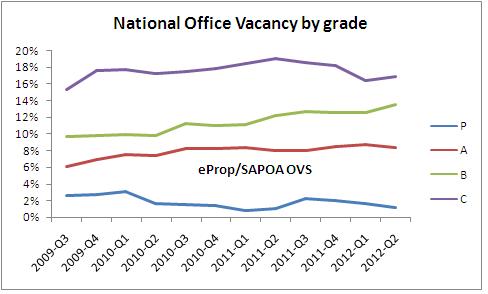
Prime space continues to perform substantially better than lower grade stock with "P" grade offices trending below 2% and "A" Grade below 9%. Negative take up appears to have impacted "B" grade offices the most judging from the trend; and from the fairly volatile trend, C grade space appears to be the subject of refurbishing strategies undertaken by landlords in pursuit of the Prime grade market.
We highly recommend that managers/funds with office assets consider listing their stock on eProp to improve their chances of letting and selling.
Brave new world for professionally managed property funds
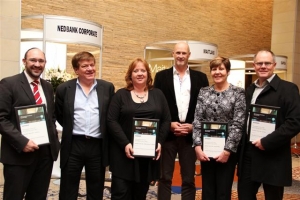
At an awards ceremony in Cape Town, Vukile Property Fund Limited - a listed property fund - recorded the highest annualised total return over a three-year period, based on un-geared property data for the funds measured by IPD. Delegates at the IPD investment conference, at which the awards were issued, have also heard of numerous challenges and opportunities facing the investment property industry in SA and Africa and how some funds and developers are adapting. And there is a clear message of hope gained by seeing the opportunities for what they are and adapting accordingly
Changing world, changing real estate business:
The property world and business environment is changing in tandem with macro global forces and micro market nuances. This is just one of a number of themes that eProp picked up at the IPD conference in Cape Town South Africa over 18-19 July 2012.
The Property Decade
Over the last 10 years ungeared investment property in South Africa, whether this be listed or unlisted, delivered astounding compound total returns of 407%. This performance is well ahead of other asset classes with equities delivering 314% total returns over the last decade, bonds 208% and cash 135%. However, there are rough waters ahead which need to be carefully navigated
Joburg & Cape Town's 10-year commercial property performance trumps global cities
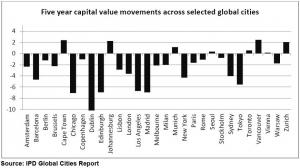
It claims to be the lightning capital of world, but however dubious this title may be, Johannesburg has avoided being struck by the global property crash as its offices, shops and warehouses outperformed those in every other global city outside of South Africa over the last decade. Analogous to a tale of 'havens' and 'have-nots', commercial property is a key measure of economic vitality, since strong retail, leisure and industrial performance encourages investors such as pension funds to buy up buildings to earn income through rental income and capital value increases
Learning from the past to understand the future of real estate investment

Identifying future trends and learning important lessons from the past are both essential for property investment in a challenging global and domestic marketplace. This is what the 10th Annual Investment Property Databank (IPD) Property Investment Conference is doing for investors.
Commercial returns in Europe fall behind; UK leases get shorter

Commercial property in the US, Canada, and Australia outperforms Europe in the first quarter of 2012; this as the UK market adapts with shorter lease terms in order to match business risk and flexibility requirements
Stan Garrun
Over time IPD South Africa has formed a very good relationship with eProp in terms of our use of the site, in collaborative work, and as an advertiser. We have always worked well with the company and its staff. We commend the eProp portal and its services as being well tuned into and focussed on the Property Industry by providing an immense ‘one-stop’ news source, as a purveyor of quality research and statistics, and as hosting state-of-the-art commercial property listings and other online products. In our view the company makes an important contribution to property industry data and business information.
Stand Garrun, IPD SA Managing Director

eProperty News is a leading online commercial property marketplace serving the Southern African Investment, Office, Retail and Industrial property and allied sectors.